
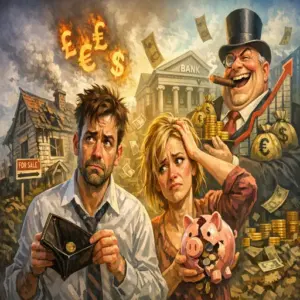
 Financial freedom has never been more misunderstood — and that’s exactly how the system likes it
Financial freedom is the modern citizen’s favourite bedtime story: a soothing tale whispered by banks, governments, and your uncle who still believes interest rates are a form of divine blessing. However, the moment you scratch beneath the glossy brochure of “responsible adulthood,” you discover a darker truth: the very behaviours we’re told will make us secure — saving money in a bank, buying a house, clinging to “safe” assets — are the same behaviours quietly draining our wealth.
Moreover, this isn’t a conspiracy; it’s simply how the machinery works. Inflation nibbles at your savings like a mouse with a PhD in economics. The banking system extracts value with the enthusiasm of a toddler discovering sugar. Property investment, once the golden calf of middle‑class aspiration, now resembles a slow‑motion financial trap disguised as a three‑bed semi with “character.”
And since Tim & Yogi’s Ride is literally pedalling across countries to raise money for good causes, it feels morally appropriate to point out that the world’s financial systems are pedalling in the opposite direction — straight into your wallet. If you’d like to support someone actually doing something productive with their time, you can donate through the Tim & Yogi’s Ride fundraising page.
The Hidden Cost of “Financial Security”
The phrase “financial security” is the economic equivalent of a comfort blanket — warm, fuzzy, and completely useless in a storm. For decades, society has preached that buying a house is the ultimate badge of success. However, the reality is closer to a lifelong subscription to debt, maintenance costs, and the existential dread of watching your roof tiles fly off during a storm.
Property investment is sold as a path to wealth creation, yet the numbers tell a different story. According to the Bank of England, house prices rose 60% between 2010 and 2020 — impressive until you adjust for inflation and discover your “gain” is about as real as a politician’s promise.
Moreover, the cultural obsession with home ownership serves institutions far more than individuals. Mortgages lock you into decades of predictable payments — predictable for the banks, that is. You, meanwhile, get the privilege of paying interest that could fund a small moon landing.
And let’s not forget the psychological trap: owning a home is marketed as adulthood, responsibility, and stability. In reality, it’s often a gilded cage with a leaking boiler.
If you want to see what real freedom looks like, visit Tim & Yogi’s website — no mortgages, no banks, just a man, a dog, and a bike.
How Inflation Quietly Steals Your Wealth
Inflation is the silent pickpocket of the modern age. It doesn’t shout, it doesn’t break windows, it simply erodes your purchasing power while smiling politely. Governments call it “economic vitality,” which is a charming euphemism for “your money is worth less every year.”
The average inflation rate in the UK between 2020 and 2025 was 3.2%. Meanwhile, the average savings interest rate was 1.8%. This means that every pound sitting in your savings account is slowly dissolving like a sugar cube in hot tea.
Moreover, inflation benefits borrowers — especially large institutions — while punishing savers. It’s a wealth transfer mechanism dressed up as macroeconomic policy. The banking system loves it because it keeps you obedient, compliant, and convinced that “saving” is virtuous.
However, saving in a bank during inflation is like trying to store ice in a sauna. You can do it, but don’t expect results.
The Banking System’s Profit from Your Fear
The banking system thrives on one thing: your fear of risk. Banks have spent decades convincing the public that they are the guardians of financial stability. In reality, they are the guardians of their own profit margins.
Global bank profits reached $1.3 trillion in 2025. That’s trillion with a “t,” the kind of number that makes you wonder whether you should have become a banker instead of a functioning human being.
Moreover, 70% of retail deposits earn below inflation. This means the bank is literally making money by holding your money while you lose money. It’s a beautiful system — for them.
The psychology is simple: people fear losing money more than they fear slowly becoming poorer. Therefore, they accept low interest rates, hidden fees, and the general indignity of being financially milked like a docile cow.
If you want to see someone who refuses to be milked, check out the Komoot route for Tim & Yogi’s Ride — that’s what actual movement looks like.
Rethinking Ownership: Freedom Beyond the Mortgage
Ownership is often mistaken for freedom. However, freedom is not the ability to own things; it is the ability to walk away from them. A mortgage is not ownership — it is a long‑term rental agreement with extra paperwork and a side order of anxiety.
Moreover, 42% of millennials prefer renting for flexibility. This isn’t laziness; it’s a rational response to a system that punishes long‑term commitments with unpredictable costs.
Financial freedom requires rethinking what ownership means. It is not about accumulating assets; it is about eliminating obligations. It is not about property investment; it is about autonomy.
Tim & Yogi understand this better than most — their entire journey is a testament to freedom through movement, not possession.
Building Real Wealth Through Active Value Creation
Here’s the part where we stop criticising the system and start offering solutions — because sarcasm is fun, but financial empowerment is better.
Real wealth creation comes from:
- Entrepreneurship
- Skill development
- Value creation
- Productive investment
- Creative risk‑taking
Self‑employed individuals report 27% higher net‑worth growth. Digital asset investment is up 45% year‑on‑year. Micro‑entrepreneurship is exploding globally.
Moreover, active investment — not passive saving — is the engine of financial freedom. Wealth is not stored; it is generated. It is not protected; it is created. It is not inherited; it is built.
A Final Word on Escaping the Wealth Trap
The path to financial freedom is not paved with savings accounts, mortgages, or polite conversations with bank managers. It is paved with awareness, autonomy, and the courage to reject outdated financial obedience.
Moreover, the world rewards those who create, not those who comply. It rewards movement, not stagnation. It rewards value, not fear.
Tim & Yogi are out there proving that freedom is not a theory — it is a practice. And if they can cycle across countries and their islands, you can certainly cycle out of the systems designed to keep you financially stationary.