
 Pay-Your-Future-Self Rule and the Psychology of Smarter Wealth
The pay‑your‑future‑self rule isn’t a motivational slogan or a TikTok trend—it’s behavioural engineering disguised as common sense. Automate saving and investing before spending a single cent, and you transform ordinary income into compounding assets that quietly multiply while you’re distracted by the next shiny thing.
Now, let’s dismantle the myths, mock the nonsense, and build a financial philosophy that actually works.
Pay‑Your‑Future‑Self Rule and the Psychology Behind Saving Before Spending
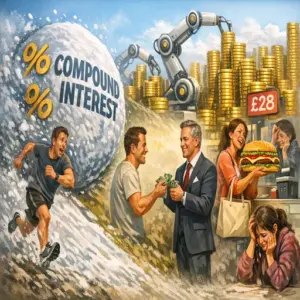
The pay‑your‑future‑self rule reframes saving as self‑respect rather than sacrifice. Every pound you save is a gift to your future self—the one who’s begging you to stop buying £28 sandwiches that taste like regret.
Behavioural economists at Duke University found that automatic saving systems outperform manual ones because they bypass emotion. Motivation is fickle; automation is faithful. Saving first removes the drama from finance and replaces it with discipline. It’s not about deprivation—it’s about dignity.
Automation: The Secret Weapon of Ordinary Millionaires
Automation is the toothbrush of wealth: if you don’t do it automatically, you probably won’t do it at all. Vanguard’s 2025 investor behaviour study revealed that automated contributions outperform manual saving by 42% in consistency. That’s the difference between “I might retire someday” and “I’m retiring early with a smug grin.”
Automation works because it eliminates excuses. It doesn’t care if you’re tired, distracted, or emotionally compromised by a sale on scented candles. It just saves. Ordinary millionaires aren’t extraordinary—they’re just boringly consistent.
This principle powers Tim & Yogi’s Ride — a journey of discipline, humour, and purpose that turns kilometres into kindness. If you want to support that mission, you can donate through the GiveWheel fundraising page. And if you’d like to see the route itself, explore the Komoot tour.
The £28 Habit That Keeps You Poor
Lifestyle inflation is the villain of modern finance. It whispers, “You deserve it,” every time you buy something ridiculous. The US Bureau of Labour Statistics shows that small daily indulgences drain thousands annually. That’s the £28 Trap—the latte factor’s posh cousin.
Each unnecessary purchase is a tiny betrayal of your future freedom. The tragedy? You could have invested that £28, let compounding work its magic, and bought yourself decades of peace instead of a sandwich that tastes faintly of despair.
Compounding Returns: Turning Patience Into Profit
Compounding returns are the universe’s way of rewarding patience. Historically, the S&P 500 has averaged about 9% annual growth over 30 years. That means £1,000 invested becomes £13,000—without you lifting a finger.
Albert Einstein allegedly called compound interest “the eighth wonder of the world.” He wasn’t wrong. It’s the quiet multiplier that turns discipline into destiny. The trick? Stop fiddling. Let time do its job. Compounding is the closest thing to magic that doesn’t involve a wand or a suspicious man in a cape.
Money, Marriage, and the Myth of Financial Happiness
Money isn’t just maths—it’s emotion, identity, and occasionally the reason two people who once loved each other now argue about who bought the expensive blender. The American Psychological Association reports that financial stress is a leading cause of relationship breakdowns.
The pay‑your‑future‑self rule reduces that stress by creating predictability. Predictability breeds stability; stability breeds peace. Financial discipline is not just a wealth strategy—it’s a relationship strategy. Fewer surprises, fewer arguments, fewer tears over air fryers.
Automation, Identity, and the Philosophy of Wealth
Your bank account is a mirror. It reflects your habits, impulses, and priorities. The pay‑your‑future‑self rule is a moral stance disguised as a financial one. It says, “I choose the version of me who will exist in ten years over the version of me who wants a shiny thing right now.”
It’s delayed gratification weaponised. Discipline disguised as self‑care. The adult version of eating your vegetables—except the vegetables grow into a forest of freedom.
The Social Comedy of Consumer Culture
We live in a world where people work 40 hours a week to buy things they don’t need, to impress people they don’t like, with money they don’t have, while complaining they can’t save. It’s tragic. It’s hilarious. It’s also entirely avoidable.
The pay‑your‑future‑self rule flips the script: saving becomes the default, spending the optional extra. It mocks the myth that wealth comes from hustling harder. It celebrates the quiet dignity of boring discipline. It’s the comedy of compound interest meeting the tragedy of takeaway lunches.
How Small Habits 10x Lifetime Income
Can small habits really 10x your income? Yes—because mathematics doesn’t care about your feelings. Automate saving 10–20% of every income stream, invest it consistently, and compounding does the rest. Over the decades, the multiplier effect has become enormous.
This isn’t magic or luck. It’s arithmetic wearing a superhero cape. The pay‑your‑future‑self rule turns ordinary earnings into extraordinary outcomes through sheer predictability.
A Final Reflection on Wealth, Freedom, and the Future Self
The pay‑your‑future‑self rule isn’t about deprivation—it’s about liberation. It frees you from lifestyle inflation, financial anxiety, and the myth that working harder is the only path to wealth. It’s a philosophy of respect—for your time, your future, and your potential.
Imagine your future self looking back with gratitude instead of regret, holding a portfolio built not on luck but on discipline. That’s the real miracle of money: not earning more, but keeping more.